
Search how to open a Pilates studio and page one hands you a startup figure somewhere between $30,000 and $350,000. Both numbers are accurate. They are just from different countries.
The American guides that dominate this search are priced for American rents, American build-out standards and American employment law. The Australian pages that get the money right tend to stop at the money, and say almost nothing about running the place once the doors open. So you end up with either a realistic budget and no operating plan, or a detailed operating plan built on numbers you cannot use.
This guide covers nine steps in the order you actually do them: Australian costs, Australian award and insurance obligations, and the admin load most first-time owners discover about six weeks in. The studios that hold up are rarely the ones with the best fit-out. They are the ones where the systems were decided before opening day.
Key Takeaways
- The Australian number is not the American number. Expect $30,000 to $120,000 here, against US$150,000 to US$350,000 there, and the gap is rent, fit-out standard and build-out scope rather than ambition.
- Decide your class model before you buy a single reformer. Class size sets machine count, machine count sets floor area, and floor area sets the lease you sign for the next five years.
- Allow roughly 8 to 10 sqm per reformer station. A 100 sqm floor takes 10 to 12 machines once you allow for circulation, reception and storage.
- The lease is the least reversible decision you will make. Negotiate a month rent-free for each year of term, and find out exactly when your bank guarantee is released.
- Get instructor engagement right before you hire anyone. An ABN does not make someone a contractor, and Fair Work now weighs the substance of the relationship over the label on the paperwork.
- A full timetable is not a profitable one. Studios pay at 75 to 85 per cent class occupancy, and you cannot manage that number if you are not capturing it.
Step 1: Decide What Kind of Studio You Are Actually Opening
Most people start by pricing reformers, which is the third decision, not the first.
Three choices set every cost that follows, so make them in this order.
Mat, reformer, or hybrid. Mat is the cheap way in. A starter kit of mats, props and flooring runs $5,000 to $10,000, and group mat classes sell casually at $20 to $30. Reformer costs far more to set up but sells at $30 to $45 a class and fills better than almost anything else in boutique fitness. One industry benchmark puts reformer fill rates near 94 per cent against barre at roughly 45 per cent, which explains why so much new capacity is going into reformer despite the equipment bill.
Home or commercial. A home studio is the lowest-capex entry available and the one most likely to be quietly non-compliant. Step 6 covers what actually decides that.
Independent or franchise. A franchise hands you systems and real negotiating leverage. Fitness franchise groups routinely secure rental incentives of up to 25 per cent on new retail leases, which an individual operator will struggle to match. What you give up is control over pricing, timetable and brand. Franchise groups are actively recruiting Australian Pilates operators right now, so it is worth pricing the option properly rather than dismissing it on instinct.
Write your model down in one sentence before you price anything. If you cannot complete “I am opening a ___ studio for ___ clients running ___ classes a week”, you are not ready to look at tenancies.
Step 2: Work Out What It Really Costs in Australia
Two bands cover almost every Australian studio: $30,000 to $50,000 for a basic four-reformer fit-out, and $70,000 to $120,000 for a commercial space with eight machines or more. Everything below is how you get to those figures, line by line, in Australian dollars.
| Line item | Typical Australian range |
| Reformer, per machine | $2,400 to $4,000 mainstream; $8,500+ premium imported |
| Cadillac or tower unit | $5,000 to $7,000 each |
| Chairs, barrels, props | $500 to $2,000 each |
| Fit-out, all in | $1,500 to $3,000 per sqm |
| Flooring | $50 to $100 per sqm |
| Lighting | $2,000 to $4,000 |
| Mirrors and storage | $1,000 to $3,000 |
| Rent, suburban | $800 to $1,500 per month |
| Rent, prime city | $1,500 to $3,000+ per month |
| ABN | Free |
| Business name registration (ASIC) | $39 for one year, $92 for three |
| Company registration (Pty Ltd) | $636 from 1 July 2026 |
| Public liability insurance | $600 to $1,200 per year |
| Professional indemnity insurance | $400 to $900 per year |
| Studio management software | $50 to $200 per month |
| Website | $1,500 to $4,000 |
| Branding and signage | $500 to $2,000 |
| Launch advertising | $500 to $2,000 per month early on |
American guides quote US$150,000 to US$350,000 for what sounds like the same studio, and premium builds in high-rent cities past US$450,000. Those figures are real, but they reflect higher market rents, heavier permitting and build-out, and a more expensive fit-out standard. Discount them rather than averaging them into your budget.
Two numbers belong in every plan and appear in almost none. Budget 20 to 30 per cent above your projection, because construction and permit timelines are the single most common overrun new studio owners report. And hold at least three months of expenses assuming zero clients, which is the reserve one Melbourne owner credits with getting her through a slow opening quarter.
The Australian entry price is genuinely lower than the search results suggest. The trap is not the capex. It is the operating cost, and that is what Step 8 is for.
Step 3: Size the Space Around Your Class, Not the Other Way Round
Every layout figure on page one of this search is in US square feet, which is no use at an inspection in Brunswick or Bondi. Here are the metric numbers.
Start from class size, not budget. The industry norm is 8 to 12 participants at a 1:8 to 1:10 instructor ratio, because reformer work needs real-time form correction. That number sets your machine count.
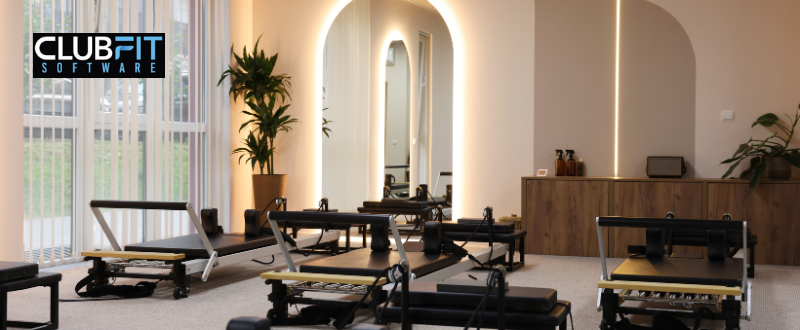
Then size the bays. A full-size reformer measures roughly 230 to 250 cm long and 60 to 70 cm wide, but the machine footprint is not the space requirement. Allow about 3 m of linear front-to-back space per reformer for full carriage travel plus instructor access at both ends, and at least 60 cm side clearance between machines so clients can mount and dismount safely. Call it 8 to 10 sqm per station.
That gives you a working rule: a 100 sqm floor takes 10 to 12 full-size reformers.
The part first-time owners miss is everything that is not class floor. An eight-reformer studio needs roughly 84 to 102 sqm in total, of which 28 to 46 sqm goes to reception, change, storage and circulation. Around a third of your tenancy earns nothing directly, and none of it is optional.
Before you shortlist a space, check:
- Ceiling height clears 2.4 m, more if you want tower or half-trapeze work
- No bulkheads or services cutting into the reformer bays
- Enough frontage for reception without stealing class floor
- Amenities that will not need building from scratch
If a space fails these numbers, walk away from it. Reformer bays cannot be compressed later, and the extra machine you squeeze in is the one clients keep bumping into.
Step 4: Negotiate the Lease Before You Fall in Love With the Space
The lease gets signed first and thought about least. It is also the one decision you cannot undo by working harder.
Rent is your second-largest cost after instructors, and Australian commercial leases have more give in them than most first-time tenants realise. Come to the table with specific asks:
- Push for one month rent-free per year of term. A five-year lease should carry roughly five months of rent-free time as a fit-out contribution.
- Establish the bank guarantee amount and its release date. Guarantees are commonly held for months after the lease ends. One Australian owner’s ran six months past expiry, and that cash is dead capital until it comes back.
- Model net effective rent, not headline rent. Subtract the value of rent-free months and any fit-out contribution, then divide across the term. Two tenancies advertised at the same rent can differ by a lot once incentives are counted.
- Confirm the use is permitted before signing. Check the building classification suits a fitness use. AUSactive publishes planning and building guidance for fitness businesses, and a change of use can add both cost and months.
- Understand your make-good obligation. At $1,500 to $3,000 per sqm, fit-out cuts both ways when the lease ends.
Then hold three months of expenses on the assumption that nobody walks through the door.
A studio that opens in an average space with cash in reserve survives a slow first quarter. A studio that opens in a beautiful space with none does not. That gap has almost nothing to do with how well either owner teaches.
Step 5: Buy Equipment in the Right Order
The same word covers a $2,400 machine and an $8,500 one. Worth knowing what the spread actually buys, particularly since most equipment advice online is written by companies that sell reformers.
Mainstream Australian studio-grade reformers sit around $2,400 to $4,000. Premium imported machines run past $8,500 each once you add extras and a spare set of springs. The premium tier buys longevity, resale value and a brand signal. It does not buy a better class on day one.
Second-hand is a real option here, with dedicated refurbished and ex-demo ranges at several Australian suppliers plus an owner-to-owner market. It is most defensible when three things are true at once: the seller is a closing studio offloading a matched set with service records, the machines are under three years old, and you can inspect them in person. Outside those conditions the risk shifts quickly. Budget $200 to $450 per machine for interstate freight, and remember that mismatched machines across a row make an inconsistent class to teach.
Buy in stages. Order to match the timetable you can fill now, not the one you hope for in year two, and leave the empty bays sized and ready.
One recurring cost almost nobody mentions: springs, upholstery and carriage servicing run about $1,000 to $3,000 a year. Environment matters too. One Australian owner near the coast watched high-grade metal on new equipment rust within months from salt air.
If you are unsure, buy fewer good machines rather than more cheap ones.
Step 6: Sort the Legals, Insurance and Council Approvals
Compliance is the cheapest part of opening a studio and the part most likely to stop you. Business setup costs a few hundred dollars. The approval you did not check can cost you the site.
Business setup. An ABN is free. Registering a business name with ASIC costs $39 for one year or $92 for three. Registering a Pty Ltd company costs $636 from 1 July 2026. GST registration becomes mandatory once turnover passes $75,000, which a reformer studio will cross. If you have been reading American guides about LLCs and EINs, none of that applies here.
Insurance, and what the policies actually do. Every guide quotes a premium. Almost none explain the products. Public liability responds to injury on your premises or during your services: strains, fractures, falls, plus property damage and legal costs. Professional indemnity responds to claims about the instruction itself, including inadequate supervision or advice. They are separate policies and a studio needs both. Expect roughly $600 to $1,200 a year for public liability and $400 to $900 for professional indemnity, with most studios carrying $5 to $10 million in cover. Insurers underwrite partly on instructor qualifications, which connects directly to Step 7.
Home studios, where client visits are the trigger. With no clients attending, running a business from home is generally ancillary residential use and needs no approval. Once clients attend, it almost always requires a development application or a complying development certificate. Check the Section 10.7 planning certificate for your property to confirm whether Home Business or Home Industry is a permitted use in your zone. Councils assess traffic, parking, the number of non-resident employees, business floor area and noise, and standard NSW planning instruments cap non-resident employees at two. Rules vary by state and council, so confirm with yours before you spend anything.
Clear this layer before you commit to fit-out, not after.
Step 7: Hire Instructors Without Creating a Fair Work Problem
Most new owners copy whatever their old studio did, which is exactly how the mistake spreads.
The Fitness Industry Award 2020 (MA000094) covers fitness studios in Australia, and qualified Pilates instructors sit above Level 7 under it. For scale, a Level 1 casual is $32.18 an hour including the 25 per cent casual loading, so a qualified instructor sits well above that. Real market rates back this up: the base wage for a qualified Australian instructor sat around $50 an hour as at mid-2024, up from roughly $35 in 2019, and casual per-class rates of $30 to $40 are commonly quoted.
Then there is the question that decides your entire cost model. An ABN does not make someone a contractor.
The ATO test turns on three questions, and in a reformer studio they all tend to point the same way:
- Who supplies the equipment? You do. The reformers are yours.
- Who controls how the work is done? You do. You set the timetable, the class format and the room.
- Who carries the commercial risk? You do. The instructor gets paid whether the class fills or not.
Answer those honestly and most studio instructors look like employees. Recent changes to the Fair Work Act mean the real substance and practical reality of the relationship govern, not the label on the contract.
Getting it wrong is expensive rather than embarrassing. Misclassification exposes you to superannuation backdated to the start of the arrangement, plus workers compensation liability. Australian instructors have already been reporting missing agreements and inconsistent payment terms to their union, and compliance attention in this industry is rising, not falling.
Price the real cost when you plan: award rate, plus casual loading, plus superannuation, plus workers compensation. That loaded figure is why instructor wages land at 35 to 45 per cent of studio billings, and it is the number Step 8 needs.
Default to employment under the award unless you have advice telling you otherwise, and put anything else in a signed agreement. None of this is legal advice, so check with Fair Work or an adviser before you hire.
Step 8: Set Prices and Build a Timetable That Actually Pays
A studio can run a visibly busy timetable and still lose money. Occupancy is the number that decides, not bookings.
Start with what the Australian market charges in 2026:
| Class type | Typical price |
| Group reformer, casual | $30 to $45 capital cities; $45 to $55 inner-city boutique |
| Group mat, casual | $20 to $30 |
| Semi-private, 2 to 4 people | $60 to $95 |
| Private session | $95 to $150 |
| 10-class reformer pack | $300 to $380 metro; $250 to $310 regional |
| Unlimited monthly membership | $220 to $320 |
Regional studios generally sit 15 to 20 per cent under metro pricing for the same class. And note what memberships do to your maths: an unlimited membership at $220 to $320 works out to roughly $30 to $38 a class in practice, below your casual rate. Revenue per spot is always lower than your headline price, and revenue per spot is what the calculation needs.
Then run the numbers:
- Count available spots per week. Reformers times classes per week times spots per class.
- Apply a realistic occupancy target of 75 to 85 per cent. Below 70 per cent you are leaving significant revenue unearned. Above 90 per cent you are overcrowding classes and burning out instructors.
- Multiply filled spots by average revenue per spot, not by your casual rate.
- Subtract fixed monthly costs: rent and outgoings, instructor wages at the loaded cost from Step 7, software, insurance, utilities and equipment maintenance.
- Pay yourself a liveable wage inside the calculation, not out of whatever is left over. This is the step first-time owners skip, and it is why studios that look fine on paper still cannot support the person running them.
Two ratios will sanity-check the result: instructors should sit at 35 to 45 per cent of billings, and rent at or below 20 per cent of gross revenue.
Timetable design follows from the same number. Build the schedule around the slots that actually fill rather than the ones that make the grid look complete, and you can only know which those are if you are capturing attendance against bookings. A suburban studio with 12 reformers running 28 classes a week at 75 per cent utilisation is a useful reference point for what a working timetable looks like.
Set expectations on the timeline too. Covering monthly costs within three to six months is realistic. Getting your capital back takes closer to three to five years, and one Melbourne owner puts consistent profitability at one to three years in.
Step 9: Set Up Your Admin Systems Before You Open the Doors
Ask experienced owners what running a studio is actually like and the answers converge. It takes five times as long as you expect. Teaching becomes the smaller part of the job. You spend most of your week doing everything except Pilates.
That workload is not random. It is bookings, cancellations, waitlists, payments, failed direct debits, rosters and compliance, and almost all of it is predictable enough to be systematised before you open.
Live before opening day:
- Online booking with capacity limited per reformer, the constraint mat studios never have to think about
- Digital waivers captured at signup rather than on a clipboard
- Payment processing and recurring billing for memberships, running on Australian direct debit rails
- A cancellation window you will actually enforce
- Automated class reminders, which are the practical control on no-shows
- A founding-member offer and a waitlist built during fit-out, so week one is not a standing start
Add in months two to six:
- Automated waitlist backfill, so a cancellation refills itself without you touching it
- Attendance and utilisation reporting by timetable slot, which is what makes Step 8 measurable
Branded apps, retail point of sale and retention automations can wait.
Two failure modes are worth naming because they are so common. The first is running on paper until a logbook is lost or damaged and the client history goes with it. The second is quieter: owners who will not enforce their own cancellation and payment policies because they do not want to upset anyone, which produces confusion, late payments and missed sessions in fairly short order.
A good system does more than save you time. It takes you out of the confrontation, and it applies the policy the same way whether you are in the studio or not. Automation creates consistency, and consistency is what members actually respond to. Our fitness studio software page sets out what that layer covers if you want to see the functions side by side.
Sort it before you open and the admin stays in the background, where it belongs, while you teach.
FAQ
How much does it cost to open a Pilates studio in Australia?
A basic four-reformer fit-out runs $30,000 to $50,000, and a larger commercial space with eight or more machines runs $70,000 to $120,000 and up. Equipment and fit-out are the two largest line items. American guides quoting US$150,000 to US$350,000 reflect a different market, so treat those figures as a comparison rather than a budget.
How much does a Pilates studio owner earn?
There is no reliable published Australian figure, and any guide quoting one is likely using US data. The useful framing is proportional: instructors typically take 35 to 45 per cent of billings and rent should sit at or below 20 per cent of gross revenue. Your drawings are what survives after that, which is why your wage belongs inside the break-even calculation rather than after it.
Is owning a Pilates studio hard?
The difficulty is administrative rather than physical. Bookings, cancellations, waitlists, payments, failed direct debits, rosters and compliance make up most of the week, and experienced owners consistently report that teaching becomes the smaller part of the job. That load is predictable, which is what makes it manageable with the right systems.
How many reformers do I need and how much space?
Class size drives it. The norm is 8 to 12 participants at a 1:8 to 1:10 instructor ratio, and you should allow 8 to 10 sqm per reformer station. A 100 sqm floor takes 10 to 12 machines, while an eight-reformer studio needs roughly 84 to 102 sqm once reception, change rooms, storage and circulation are counted.
Can I run a Pilates studio from home?
Sometimes, and client visits are the trigger. With no clients attending it is generally ancillary residential use, but once clients attend it almost always requires council approval. Check whether Home Business or Home Industry is permitted in your zone, and expect conditions on client numbers, hours, parking and noise. Rules vary by council.
What our customers are saying
We recently converted to Clubfit and love that the system gives us end to end control of our membership experience from a single platform, from billing to full member management. The Clubfit team are enthusiastic and easy to work with, always seeking feedback to continually develop the system.
 Jindalee Fitness
A six year search led us to Clubfit. The software is easy to use and has saved us six figures annually.
It has allowed us to take total control of our membership base; both from a billing and service standpoint. The software allows us to communicate with our members more effectively, leading to happier members and ultimately, better retention. The Clubfit team are extremely receptive to user feedback and are constantly fine tuning their product / tech. They were also able to effectively and accurately migrate 20+ years of past and present member data from our old software.
 Healthworks Hendra
Clubfit has made a significant difference on the way we run our business.
The user friendly software has allowed us to save time and we have seen a remarkable increase in new member sign ups. We now only operate from one software instead of two…no more going back and forth!
The support Clubfit offers is the best we have ever dealt with and we are amazed with how quickly they respond. This is what companies should strive towards.
Get in touch
Book a free, personalised demo
See how Clubfit can empower your fitness business with its revolutionary approach to member management and guarantees to increase your revenue.
Request Demo
"*" indicates required fields